
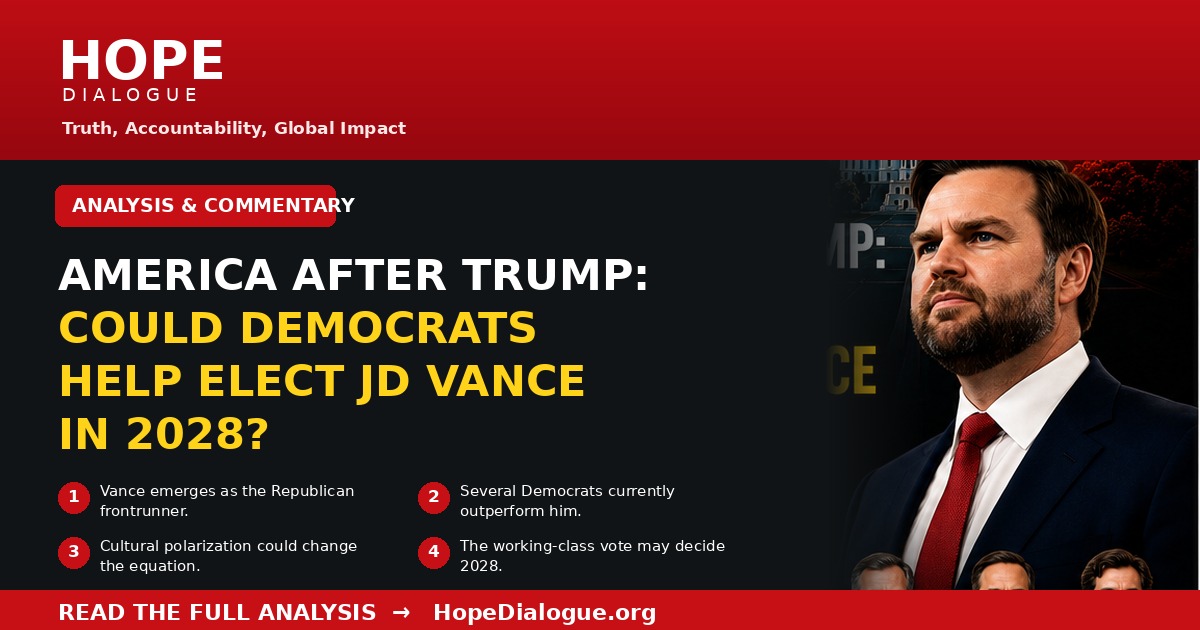
Predicting the 2028 presidential election in August 2026 would be premature. But the political forces that could determine it are already visible: an emerging Republican succession struggle, a Democratic argument over how to rebuild a broad coalition, and voters who appear more focused on everyday costs and competence than on the ideological language of either party.
The provocative premise
The phrase “Democrats’ secret plan to elect JD Vance” is deliberately mischievous. Matthew d’Ancona’s argument in The New World is not that Democratic leaders are conspiring to put Vance in the White House. It is that a party can unintentionally make an opponent stronger by choosing the wrong message, the wrong political language, or the wrong candidate for the electorate it actually has to win.
Vance is the Republican heir apparent — but not inevitable
Recent Republican polling has often placed Vance at or near the top of a hypothetical 2028 field. That matters because he is unusually well positioned to inherit the institutional and cultural network built around Donald Trump. Yet early primary polls are not a nomination certificate. They reflect name recognition, current alliances and a political environment that can shift rapidly. Marco Rubio and other Republicans still have plausible routes, and Vance would have to prove that he can inherit Trump’s coalition without possessing Trump’s singular showmanship.
The general-election picture looks different
The more interesting finding is that Vance’s strength inside the Republican Party does not automatically translate into dominance against Democrats. An August 2026 Emerson College national poll tested several hypothetical matchups. Gavin Newsom, Jon Ossoff and Pete Buttigieg each led Vance 49 percent to 44 percent, while Kamala Harris led 49 percent to 45 percent. In the same poll, Vance narrowly led Alexandria Ocasio-Cortez 46 percent to 44 percent. These are snapshots, not forecasts, but the pattern is worth watching: candidate choice appears capable of moving the race materially.
Democrats currently have an opening
The broader 2026 environment has also been favorable to Democrats. Reuters/Ipsos found voters giving Democrats an advantage over Republicans on having a better plan for the cost of living, while Emerson showed a Democratic lead on the generic congressional ballot. Other recent polling has shown substantial dissatisfaction with the administration. The immediate political opportunity is therefore straightforward: speak to household economics, competence and stability while avoiding the assumption that anti-Trump sentiment alone will build a durable majority.
The working-class problem is economic and cultural
For years, analysts have debated why Democrats lost ground with working-class voters. One camp emphasizes wages, inequality, health care, housing and the power of corporations. Another emphasizes immigration, crime, social values, identity politics and the language of elite institutions. The most useful answer may be that both are true. Voters do not experience politics in ideological silos. A person can favor stronger social protections and unions while also wanting tighter border enforcement, safer neighborhoods and political language that sounds familiar rather than academic.
Language matters more than many strategists admit
This is why the current Democratic debate over political vocabulary matters. Axios has reported on growing concern inside the party about activist and professional terminology that can sound remote from everyday life. Kentucky governor Andy Beshear’s instinct is instructive: use plain language, emphasize family, dignity, jobs and rights, and do not force voters to learn a specialized political vocabulary before they can understand what you stand for. Protecting rights and building broad majorities are not contradictory goals.
The AOC question
Alexandria Ocasio-Cortez remains one of the most talented communicators in American politics and has a genuine economic-populist appeal. Her ability to mobilize younger voters is an asset, not a triviality. But a presidential campaign would test whether that appeal can extend far enough into older, non-college, suburban and culturally moderate electorates. The early Emerson result against Vance should not be treated as destiny, but it illustrates d’Ancona’s central warning: Republicans would prefer to run against a Democrat whom they can easily define as the cultural left rather than against a candidate who forces the election back onto household economics and governing competence.
Newsom, Beshear, Shapiro, Ossoff and Buttigieg represent different routes
Gavin Newsom is visibly building a national network and testing his appeal outside California. His strengths are political skill, media combativeness and executive experience; his liabilities include the ability of Republicans to turn California itself into a campaign symbol. Andy Beshear offers almost the opposite profile: a Democrat who repeatedly wins in deeply Republican Kentucky by using culturally familiar language and a practical governing style. Josh Shapiro brings swing-state experience. Jon Ossoff’s early national matchup with Vance has been competitive. Pete Buttigieg continues to work on one of his biggest weaknesses from 2020 by investing more heavily in relationships with Black voters, including in South Carolina.
Republicans have vulnerabilities too
It would be a mistake to turn this analysis into a one-sided critique of Democrats. Republicans could easily squander their own advantages. Voters may punish a party they associate with higher prices, unpopular foreign entanglements, excessive immigration enforcement, abortion restrictions, attacks on institutions, or government that appears chaotic or captive to wealthy interests. An election that becomes a referendum on Republican overreach would look very different from one centered on Democratic cultural excess.
The Electoral College will matter more than national polling
The presidency is not decided by a national popular-vote average. Any serious 2028 analysis must eventually ask who can win Pennsylvania, Michigan and Wisconsin while building a second route through states such as Georgia, Arizona or Nevada. A candidate can lead nationally and still be poorly matched to the decisive states. That is another reason the current head-to-head polls should be read for direction rather than prediction.
Four plausible paths to 2028
The first is a Democratic restoration: the party nominates a candidate who combines economic populism, cultural moderation and institutional competence, and the election becomes a referendum on Republican governing performance. The second is a MAGA succession: Vance consolidates the Trump coalition and faces a Democrat who is easy to portray as culturally distant from swing voters. The third is a genuine realignment, with both parties competing for working-class voters through different blends of economic populism and social values. The fourth is the scenario that current Vance-centered discussion sometimes forgets: Republicans nominate someone else, and the entire strategic map changes.
A cautious prediction
If the 2028 election were held under something resembling today’s political conditions, Democrats would probably begin with a modest advantage in a number of plausible matchups. But that is a statement about the present environment, not a forecast of an election more than two years away. Wars end or expand. Recessions begin or recede. Candidates rise and collapse. Midterms rearrange coalitions. Scandals and achievements change public perceptions.
The larger democratic lesson
The deeper lesson extends beyond the United States. Across democracies, voters are resisting simple left-right categories. They are worried about economic insecurity, migration, identity, technology, inequality, religion, public order and distrust of institutions at the same time. Parties that talk only to their own professional class, ideological base or media ecosystem eventually discover that winning an internal argument is not the same as winning a country. The challenge is to defend principles without treating persuasion as betrayal.
What to watch next
The 2026 midterm results will be the first major test. After that, watch whether Vance consolidates Republican donors and activists, whether Democrats reward a culturally progressive or a broader coalition-building candidate, and whether the economy becomes the dominant issue of 2028. State-level polling in Pennsylvania, Michigan and Wisconsin will eventually matter far more than today’s national name-recognition surveys.
Selected Sources
Polling and news reporting are used as evidence; commentary pieces are treated as arguments rather than facts. Early 2028 polling is inherently provisional.
- Matthew d’Ancona, The New World — “The Democrats’ secret plan to elect JD Vance”
- Emerson College Polling — August 2026 National Poll
- Reuters/Ipsos — voters and the cost of living, Aug. 25, 2026
- Ipsos — Reuters/Ipsos August 2026 Poll
- AP — the 2026 general-election battle lines
- Axios — Democrats debate political language ahead of 2028
- Axios — AOC staff changes ahead of a possible 2028 decision
- AP — Pete Buttigieg returns to South Carolina while weighing 2028